Shelter
Exhibition
Announcing an exhibition of new work from Ben Varney, and Helen Cook in collaboration with the Fen End Bodgers.
Exhibition Dates: September, TBD
Artist Brief
Create a non-hierarchical, welcoming place of shelter and care for people with brain injuries and mental health needs on a windy, flat, unsheltered field.
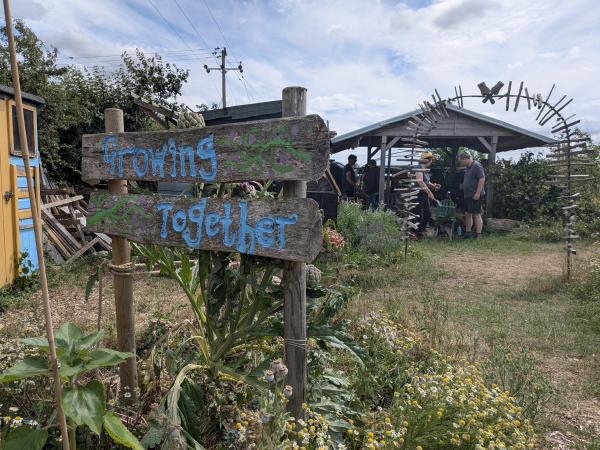
Fen End Farm is the home of the Fen End Bodgers, a recovery and support group for people with brain injuries. The group engages in woodworking, making furniture for the space and decorations like arches out of willow and pallet wood. The group also grows food on a large allotment, which is donated to Cambridge Sustainable Food. The group is supportive, non-judgemental and described by all as being an incredibly therapeutic, egalitarian, welcoming space.
The shelter should enable people to engage with the group and space in different ways to accommodate different sensory and social needs, and should provide some relief from the wind and a space to get warm. More important than building the shelter itself is the manner in which it’s built, and the materials it’s built with. Building will be done with scraps, repurposed materials, that will be transformed through care, creativity and attention into structures that are intentional, functional and beautiful in their way. Fundamental to this project is investing in relationships, to the materials, to the land and environment, and to each other. We are creating a place where everyone and everything can thrive in its niche. The intention of the artist residency is to translate this vision into practical, incremental projects, and to implement them. The work will bring the care and attention needed to build sheltered spaces specifically tailored to accommodate people with head injuries, who are often dealing with memory issues, expectation of routine, and a social need to be included in the group with a requirement for flexibility as to how much they participate. Providing accommodations reinforces a social environment that is strongly non-hierarchical and anti-authoritarian.
In stark contrast with authoritarian requirements of compliance, the accommodations in this space provide people with options and prioritise cultivating egalitarian relationships over obtaining a yield. In co-creating spaces that are comfortable for and tailored to disabled people, we are necessarily countering the othering that underlies ableist hierarchies.
Previous